Graph Editor
The graph editor is where you build and organize your Quick Menu graphs.
Opening the Editor
- Double-click a Quick Menu Graph asset in the Content Browser
- Or right-click a graph asset → "Edit"
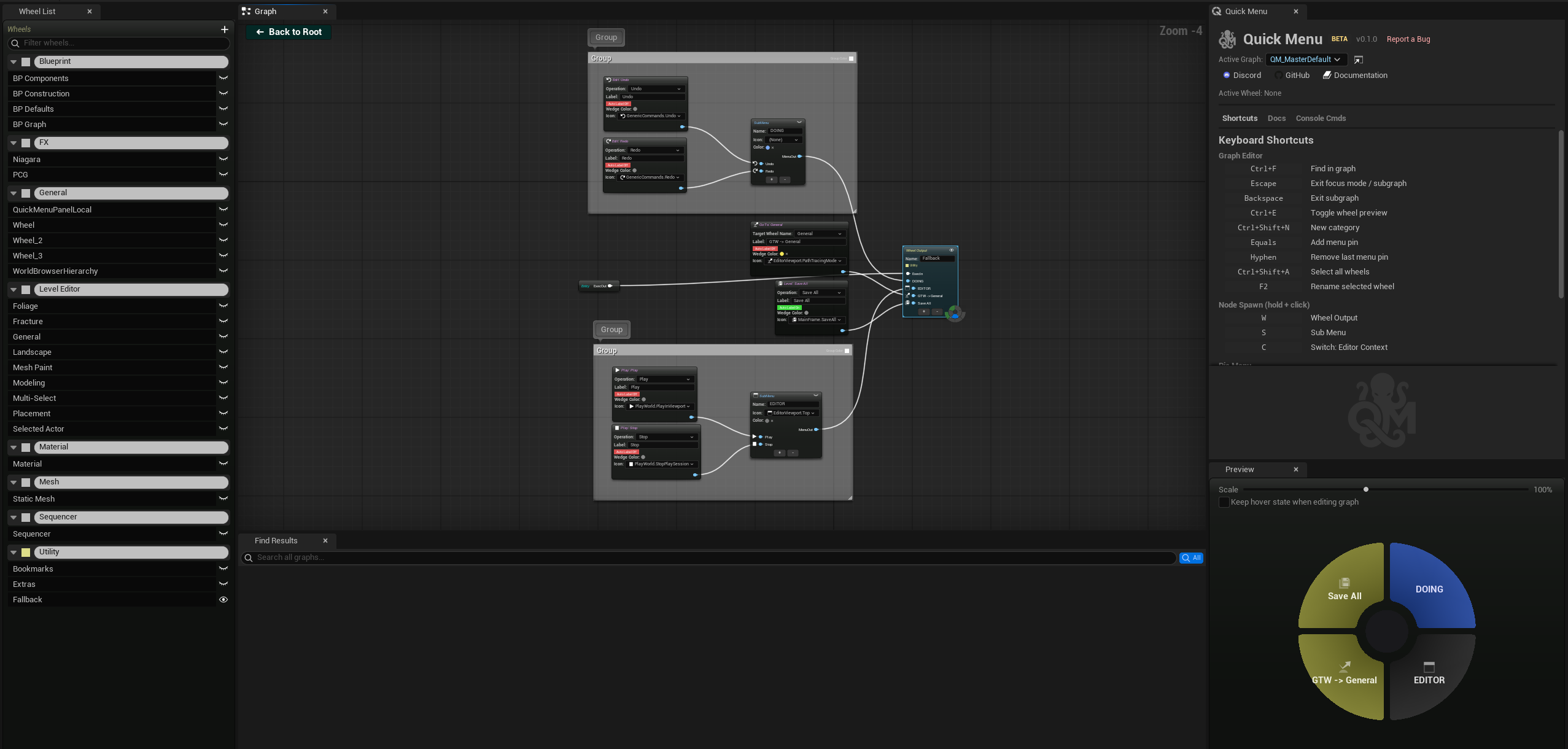
Editor Panels
Graph Canvas (Center)
The main node graph. Drag, zoom, connect nodes. Right-click for the context menu to add nodes.
- Watermark — displays "ROOT" or the current subgraph name in the bottom-right corner, similar to Blueprint editor
- Right-click menu — search nodes by name or by action/operation keyword. Results show a tree-view with the node name and the matching action underneath. Includes a "Can't find your action? Request it!" link to Discord.
- Copy-paste — Ctrl+C/V preserves all pin connections between pasted nodes
- Back to Root — when navigating back from a subgraph, the parent graph focuses on the subgraph node
Inline Property Panel on Nodes
Since 1.0.3, action node properties are edited directly on the node in the graph — no roundtrip through the Details panel for common properties.
Depending on the node type, the inline panel exposes:
- Color swatch — click to open the color picker for the wedge fill
- Label field — editable text, or auto-generated (toggle
bAutoLabel) - Type-specific options — dropdowns, enums, sliders matching the action (e.g. a Transform Mode selector on
TransformMode, a component picker onBP: Component Op) - Asset picker — for
Open Asset, browse Content Browser and pick any asset - Blueprint action picker — for
BP: Add Node, search and pick any spawnable Blueprint action
The Details panel remains available for advanced or rarely used properties; the inline panel simply covers the 90% case without a focus shift.
Wheel List (Left Sidebar)
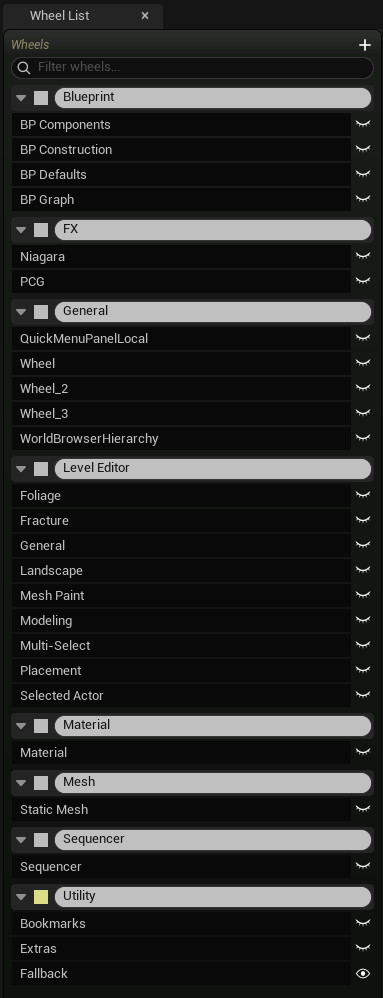
Displays all WheelOutput nodes organized by category.
Features: - Click a wheel to select it in the graph canvas and show it in the preview - Double-click to enter Focus Mode - Drag a wheel up/down to reorder within its category - Drag a wheel onto a category header to move it to that category - Multi-select with Shift (range) or Ctrl (toggle) - Search/filter box at the top — type to filter wheels by name - Right-click a wheel → Rename, Delete, Move to Category - Right-click a category header → Rename, Change Color, Change Icon, Delete Category, New Category
Category system: - Categories are collapsible groups with a colored header - Each category can have a custom color and icon - Wheels without a category appear in "Uncategorized" - New categories auto-create when you drag a wheel to the "Drop here for new category" zone - Category state (collapsed/expanded) persists between sessions
Preview Panel (Right Sidebar)
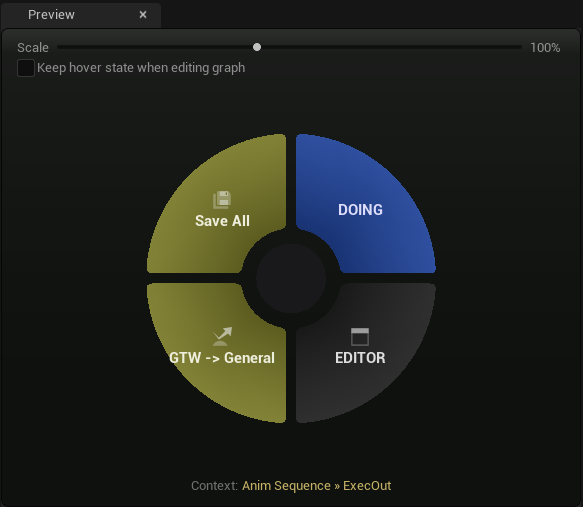
Live, interactive rendering of the selected wheel as a pie menu.
Features:
- Live updates — any change in the graph is reflected in the preview after a short debounce
- Interactive — click wedges to test actions (they execute for real), hover to see highlights
- "+" button — add actions to the wheel directly from the preview (opens action picker)
- "X" buttons — remove wedges inline
- Click-drag reorder (1.0.4) — drag wedges directly inside the preview to swap them, without first toggling Edit Mode. Each drop auto-exits the mode. Changes flow back to the WheelOutput pins so the runtime wheel reflects the new order on the next open
- Scale slider — drag to preview at different sizes (1.0x to 2.0x)
- Sub-menu expansion — hover a sub-menu wedge to see children expand as nested rings
- Toggleable — show/hide with toolbar button or Ctrl+E
What it shows: - When a WheelOutput is selected: that wheel's wedges with labels, icons, and colors - When a single action node is selected: a temporary preview with just that action - When nothing relevant is selected: the last previewed wheel
Find Results (Bottom)
Opened with Ctrl+F. Search across all nodes in the current graph.
- Type a query and press Enter — results list all matching nodes
- Double-click a result to zoom the graph canvas to that node
- Matches node names, labels, and property values (e.g., searching "Translate" finds TransformMode nodes set to Translate)
- Results show a badge indicating which subgraph the node belongs to
Focus Mode
- Double-click a WheelOutput in the Wheel List to enter Focus Mode
- Only that wheel's connected nodes are highlighted; everything else fades
- The preview panel shows that wheel
- Click the breadcrumb bar or press Escape to exit
Comment Nodes
Since 1.0.4, Quick Menu graph comments use the engine-default comment widget — exact parity with Blueprint, AnimBP, Niagara, Material comments (resize handles, contained-node move, title-bar context menu, color picker, font size adjustment). Existing comments keep all of their data (NodeComment, CommentColor, dimensions) — only the rendering changes.
- Press C with nodes selected to create a group comment around them
- Double-click to rename
- Click the color swatch to change the comment color
- Resizable — drag edges to fit your node group
- Alt+E — create a comment auto-named from the first SubMenu/WheelOutput found in selection, with a random saturated color
- Right-click a comment → Auto Name & Color — automatically renames from contained SubMenu/WheelOutput and assigns a random color
Graph Op Actions in Any Graph Editor (1.0.4)
Auto-Layout Graph, Align Horizontal, Align Vertical, Auto Name & Color Comments, and Create Comment Around Selection now operate on the focused graph editor regardless of editor type — Blueprint, Niagara, AnimBP, Material, etc. — using a new generic helper that walks the focused widget tree and finds the active SGraphEditor.
- QM-specific operations (
AddWheelOutput,CollapseToSubMenu,PreviewWheel,SetAsActive, …) keep their QM-only path Auto Name & Color Commentsfalls back to color-only on non-QM graphs (noSubMenu/WheelOutputto derive comment names from)- Comment shortcuts (
C,Alt+E) now route by user focus, so the comment lands in the editor under focus — even with multiple QM graphs open simultaneously
Two Workflows
Quick Menu supports two ways to build menus:
- Graph-first: Open the graph editor, add nodes, connect pins, see the result in preview
- Wheel-first: Press V in the editor, see what's there, add/remove actions inline with + and X buttons, press E to fine-tune in the graph
Both workflows edit the same underlying graph — changes made inline are reflected in the graph, and vice versa.